


The Majlis Park–Maujpur–Babarpur corridor india’s-first-‘ring-metro’-in-delhi has eight elevated stations and is part of the already operational Majlis Park–Shiv Vihar Pink Line.

Prime Minister Modi inaugurates India’s first ‘Ring Metro’ in Delhi
Prime Minister Narendra Modi on Sunday inaugurated two new Delhi Metro corridors, including the country’s first “Ring Metro.”
The Majlis Park–Maujpur–Babarpur (Pink Line) corridor is approximately 12.3 km long, while the Deepali Chowk–Majlis Park (Magenta Line) corridor stretches around 9.9 km.
Majlis Park–Maujpur–Babarpur Corridor –
The Majlis Park–Maujpur–Babarpur corridor includes eight elevated stations and forms part of the already operational Majlis Park–Shiv Vihar Pink Line.
With the addition of this section, the Pink Line’s total length has increased to about 71.56 km, making it India’s first fully operational “Ring Metro.”
Prime Minister Modi inaugurates India’s first ‘Ring Metro’ in Delhi
Stations on this corridor include:
- Majlis Park
- Burari
- Jharoda Majra
- Jagatpur–Wazirabad
- Sura Ghat
- Nanaksar–Sonia Vihar
- Khajuri Khas
- Bhajanpura
- Yamuna Vihar
- Maujpur–Babarpur
The corridor also features a new bridge over the Yamuna River and a double-decker viaduct designed to carry both the metro line and a road flyover.
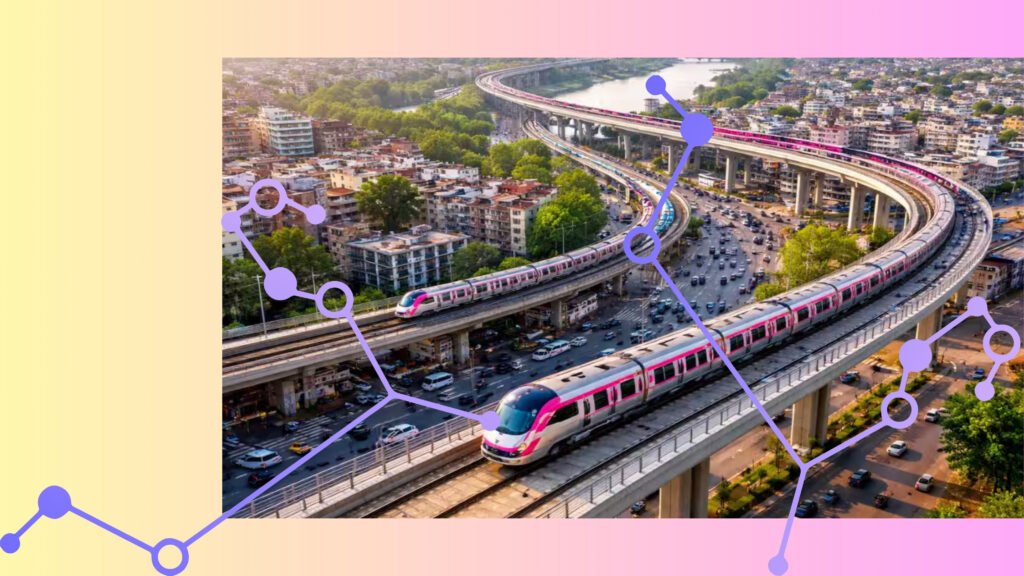
Deepali Chowk–Majlis Park Corridor,
The second corridor, Deepali Chowk to Majlis Park, is an elevated extension of the Botanical Garden–Krishna Park Extension Magenta Line and includes seven stations. With this extension, the Magenta Line’s total length has increased to about 49 km.
Stations along this section include:
- Deepali Chowk
- Madhuban Chowk
- Uttar Pitampura–Prashant Vihar
- Haiderpur Village
- Haiderpur Badli Mor
- Bhalaswa
- Majlis Park
Parts of the Deepali Chowk–Majlis Park corridor rise to a height of around 28.36 meters, making it one of the highest elevated sections in the Delhi Metro network.
Three new corridors planned for the Delhi Metro
Prime Minister Modi also laid the foundation stone for three new metro corridors under Phase-V (A) of the Delhi Metro expansion plan:
- Central Vista Corridor: Ramakrishna Ashram Marg to Indraprastha
- Golden Line Extension: Aerocity to Indira Gandhi Domestic Airport Terminal-1
- Golden Line Extension: Tughlakabad to Kalindi Kunj
According to an official statement, the Central Vista Corridor, which will be 9.913 km long, will be constructed underground and include stations such as:
- Shivaji Stadium
- Central Secretariat
- India Gate
- War Memorial–High Court
- Baroda House
- Bharat Mandapam
- Indraprastha
The statement added that this corridor is expected to improve connectivity to important government and cultural landmarks in central Delhi.
The Aerocity–Terminal 1 extension of the Golden Line India’s first ‘Ring Metro’ in Delhi will be a 2.263 km underground stretch with one new station.
Meanwhile, the 3.9 km Tughlakabad–Kalindi Kunj extension will be an elevated corridor with stations at:
- Sarita Vihar Depot
- Madanpur Khadar
- Kalindi Kunj
This extension will improve connectivity for commuters coming from Noida via Kalindi Kunj, allowing them to reach South Delhi and the airport more easily.
Prime Minister Modi inaugurates India’s first ‘Ring Metro’ in Delhi in Delhi A big step for Delhi’s metro network
The new corridors were inaugurated by Narendra Modi, marking another major expansion of the Delhi Metro, which is already one of the largest and most advanced metro systems in the world.
What makes this development particularly special is that the Pink Line now forms India’s first fully operational “Ring Metro.”
Think of it like a circular railway around large parts of the city. Instead of always traveling toward the city center and changing lines, passengers can now move around the city in a loop, making travel faster and reducing congestion on other lines.
Why the Ring Metro matters, Prime Minister Modi inaugurates India’s first ‘Ring Metro’ in Delhi
The completed India’s first ‘Ring Metro’ in Delhi Pink Line improves connectivity between North, East, and South Delhi. This means:
- Passengers can switch lines more easily without traveling to crowded central stations.
- Commutes between outer areas become much shorter and more direct.
- It helps reduce pressure on busy interchanges like Rajiv Chowk and Kashmere Gate.
The ring line now connects with several other metro lines, allowing smoother transfers across the network.
Engineering highlights of the new corridor- India’s first ‘Ring Metro’ in Delhi
Prime Minister Modi inaugurates India’s first ‘Ring Metro’ in Delhi
The Majlis Park–Maujpur–Babarpur section includes some interesting engineering features:
- A new bridge across the Yamuna River, helping extend metro connectivity to East Delhi.
- A double-decker viaduct, where the metro line runs above while a road flyover runs below.
This design saves space in crowded urban areas and improves road traffic as well.
Projects like these are important in cities like Delhi where land availability is limited.
One of the highest metro sections in Delhi
Prime Minister Modi inaugurates India’s first ‘Ring Metro’ in Delhi
Part of the Deepali Chowk–Majlis Park corridor rises to about 28 meters above ground, making it one of the tallest elevated metro sections in the city.
India’s first ‘Ring Metro’ in Delhi
Elevated tracks are often used in areas where underground construction would be too expensive or complicated due to existing buildings and utilities.
Better connectivity to major areas
Prime Minister Modi inaugurates India’s first ‘Ring Metro’ in Delhi
The upcoming India’s first ‘Ring Metro’ in Delhi metro expansions under Phase-V will improve access to several key locations in Delhi, including:
- Government zones near India Gate
- Administrative areas around Central Secretariat
- Convention and exhibition spaces like Bharat Mandapam
- Travel hubs connected to Indira Gandhi International Airport
These routes are expected to make commuting easier for office workers, tourists, and residents.
What this means for daily commuters
For people living in places like Burari, Bhajanpura, Sonia Vihar, and Yamuna Vihar, the new metro link could significantly change daily travel.
Many of these areas previously relied mostly on buses or road transport. With the metro now extending here:
- Travel times to central Delhi could drop by 30–40 minutes in some cases.
- Commuters will have more reliable and comfortable transportation.
- Traffic congestion on major roads may gradually reduce.
In simple terms:
The new corridors are not just about adding a few stations — they complete a circular metro route around the city and expand connectivity to several underserved areas, making Delhi’s public transport network even stronger.